


Fellow Climate Warriors,
In case you missed last week’s post, we painted CTC’s approach to consumer climate tech with broad brush strokes. Today, we take a deeper dive into how changing consumer sentiment is setting the table for exciting investment opportunities in the consumer climate tech landscape. Please give a huge round of applause for CTC Fund fellow Lexi Demarco for penning the below.
If you are an accredited investor and would like to learn more ping us at info@climatetechcircle.com.
Warmly,
Team CTC
CTC Investment Strategy Deep Dive
Part 1: Changing Consumer Sentiment
The sheer magnitude of the impact consumption has on the economy makes it a necessary sector to transform if we want to align growth with sustainability. Consumer spending accounts for $14Tn annually (almost two thirds of the US economy) while consumer lifestyles are responsible for two thirds of global greenhouse gas emissions. Just last week, the WSJ reported that, despite high interest rates and inflation, the US economy grew almost 5% this summer primarily powered by US consumer spending. Thus, if consumer behavior can be more sustainable, it will have an outsized impact on the economy. As we mentioned in our post last week, we have calculated the consumer climate tech market opportunity to be over $455B and expect it to grow to $1.2Tn by 2030. One of the top forces underpinning this large opportunity is consumers’ changing sentiment towards wanting a more sustainable future. Today, we are excited to highlight some research and data around changing consumer behavior and dive into more detail about how consumers, especially millennials and GenZers, are prioritizing sustainability and are voting with their wallets.
Consumer Awareness Leads to Behavior Change
From 1980-2022 there was an average of 8.5 billion-dollar climate disaster events each year in the US. However, in the past 5 years (2018-2022), the annual average has increased to 18 billion-dollar events a year. In 2023 (through October) alone there have been 24 billion-dollar climate events in the US. Due to the increasing number of devastating climate crises happening not only in the US, but across the world, there has been a rising awareness of climate change and its adverse effects. Encouragingly, consumers are recognizing the need to transition to a more sustainable future and are becoming more conscientious of their spending habits; a resounding 78% of US consumers expressed the importance of embracing a sustainable lifestyle in a recent Nielsen IQ survey.
Evident shifts in consumer behavior are aligned with this trend of sustainable consumption, encompassing the deliberate reduction of purchases with plastic packaging, a preference for goods crafted from recycled or sustainable materials, and a willingness to invest more in sustainable products. Consumers are also opting for energy-efficient household appliances and transitioning their homes and transportation to renewable energy sources. Pew Research found that two thirds of US adults believe that our country should prioritize the development of alternative renewable energy sources versus expanding oil and coal production.
Consumers are not just talking about making sustainable purchases, but are actually doing it. McKinsey and NielsenIQ tracked the actual spending behavior of consumers instead of self-reported intentions and found that there is a material link between ESG-related claims and consumer spending, with ESG products resulting in a CAGR of 6.4 percent from 2018-2022 as compared to a CAGR of 4.7 for products that made no such claims (See Exhibit 1). This further underscores that consumers are putting their money where their mouth is.
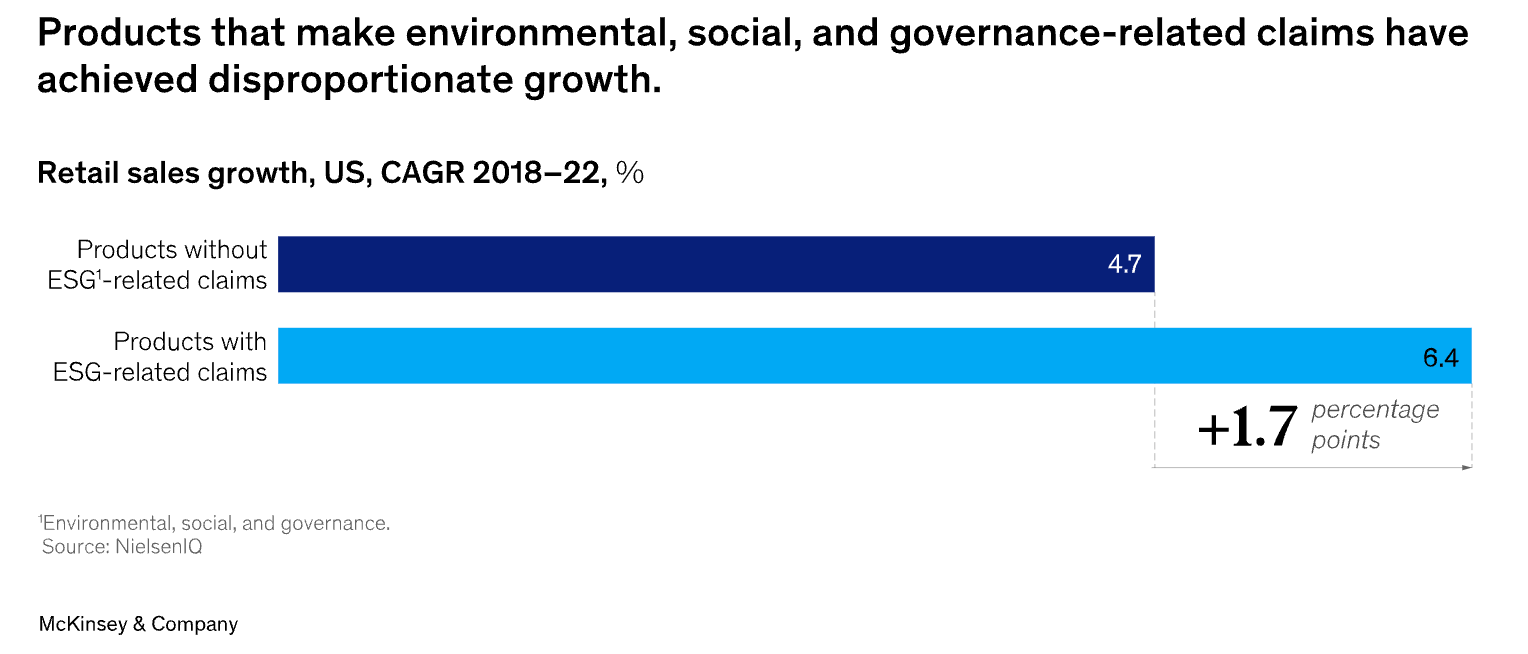
Exhibit 1 - Source: McKinsey & Company
Generational Shift
Another driving force is that the next decade will witness a significant transformation in both the workforce and population dynamics, largely driven by Millennials and GenZ. Combined, these two generations currently represent 43% of the US population and 49% of the global population. As we move forward, they are on the cusp of inheriting a substantial wealth transfer amounting to tens of trillions of dollars.
A defining feature of these generations is their formative experiences amidst pivotal global events, including but not limited to the COVID-19 pandemic, the Black Lives Matter movement, and an unending series of natural catastrophes. These occurrences have profoundly shaped their perspectives, engendering a heightened concern for environmental and social matters that transcends that of preceding generations. Seventy-five percent of Millennials are eco-conscious to the point of changing their buying habits to favor environmentally-friendly products. Additionally, 62% of GenZers prefer to buy from sustainable brands and 73% are willing to pay more for sustainable products (Exhibit 2). These statistics signify that the impending influence of these two generations will play an outsized role in shaping future consumption patterns.
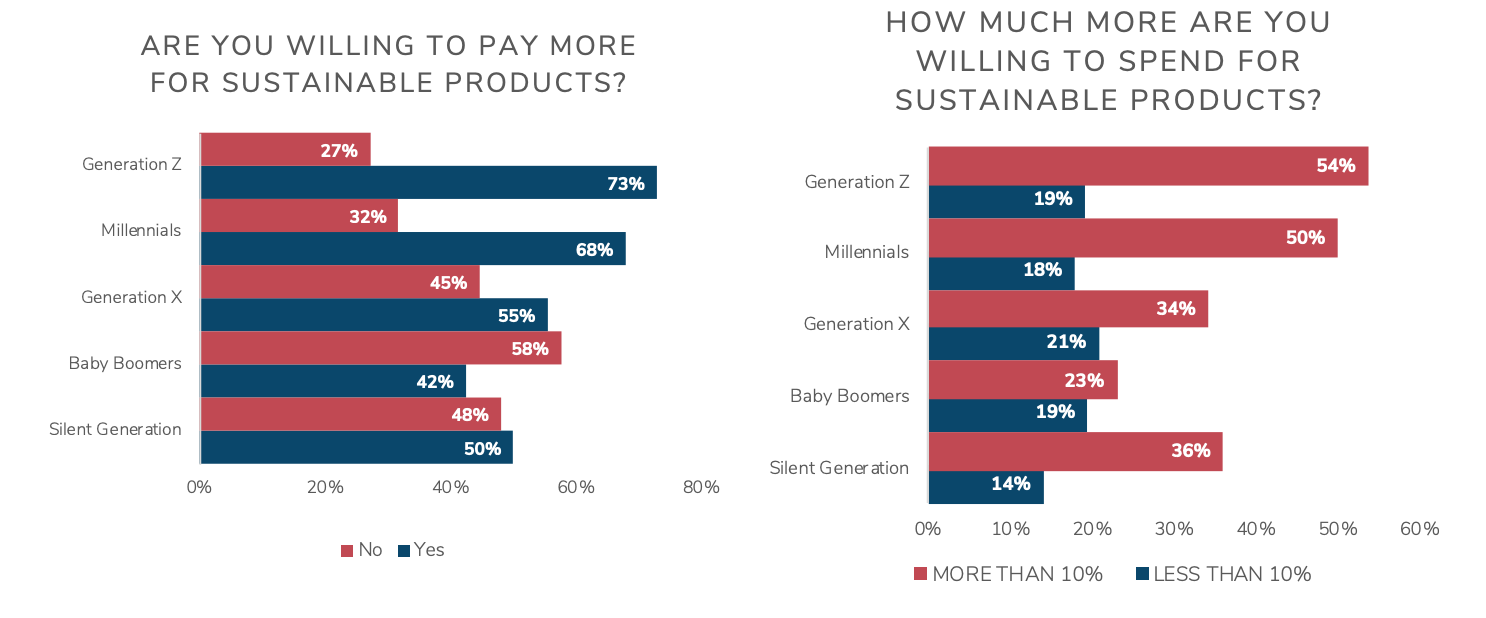
Exhibit 2 - Source: FirstInsight
In a market where consumer preferences have considerable influence over the products and services available, it's evident that the momentum is surging toward a greater emphasis on sustainability. This trend underscores our conviction that the consumer climate tech sector will provide a massive opportunity over the next decade.
Next week: Regulatory Forces Driving Change
Now that we've explored the evolving consumer sentiment towards sustainability, which is spurring an increased demand for more environmentally responsible products from corporations, next week, we will delve into another critical factor shaping corporate behavior: government regulations and incentives related to sustainability.