


Fellow Climate Warriors,
We’re back in action again with the 3rd deep dive into our fund’s consumer climate tech investment strategy.
But first, ICYMI, we launched Climate Tech Coffee this week! Exclusive for Climate Tech Cocktails Substack subscribers, Coffee is a shorter caffeine-infused version of Cocktails.
Also, don’t forget to submit your application for the 2nd cohort of our CTC Fund Fellowship. Do you want some hands on climate tech VC experience while helping laey the foundation for CTC Fund II? Say no more and APPLY HERE today!
Also, we launched our very first CTC Marketing Fellowship! Learn more about our marketing fellowship and APPLY HERE while the gettin’s good!
Alriiight, alriiight, alriiight. Back to the main course. Today we tap the surface about how corporates are going to need consumer climate tech solutions to ultimately hit the metrics they need to hit in order to meet their ESG targets. Round of applause for CTC Fund fellow Elizabeth Blankenship for penning this post.
If you are an accredited investor and would like to learn more ping us at m@climatetechcircle.com.
Warmly,
CTC
CTC Investment Strategy Deep Dive
Part 3: Corporate Response
Corporate Sustainability: A Response to Shifting Consumer Demand and Emerging Regulations
One of the biggest, and easiest, proof points that consumer climate tech is the next big thing can be found at the highest level of American capitalism: corporations. Over the past two weeks we’ve examined two profound forces at the forefront of this sustainable shift, compelling corporations to reevaluate their practices: the pull of consumer demand and the regulatory push from governments. Now, we dive into how corporations are responding to these dual pressures and are building a more sustainable future. Corporations are at a crossroads, keep up or be left behind. But, what does that actually mean?
Corporations both large and small are taking sustainable action in two pivotal ways: by implementing corporate-level changes in Environmental, Social, and Governance (ESG) policies and by creating more sustainable products.
Response #1: Making Corporate-Level ESG and Sustainability Changes
The rise of ESG criteria is reshaping how companies manage and govern themselves. ESG is not just a buzzword; it's now a critical consideration for investors and management alike. Companies are drastically shifting long-term goals at the highest corporate level, and, because regulations now prevent corporations from making false claims, we know that this turn towards sustainability is real. According to the G&A Institute, 96% of S&P 500 companies and 81% of Russell 1000 companies now publish ESG reports in some form. These reports provide quantifiable metrics, revealing the extent to which companies are making real changes to their operational processes and supply chain practices. It looks like we’re close to a world where 100% of the world’s biggest corporations are transparently reporting their carbon footprints.
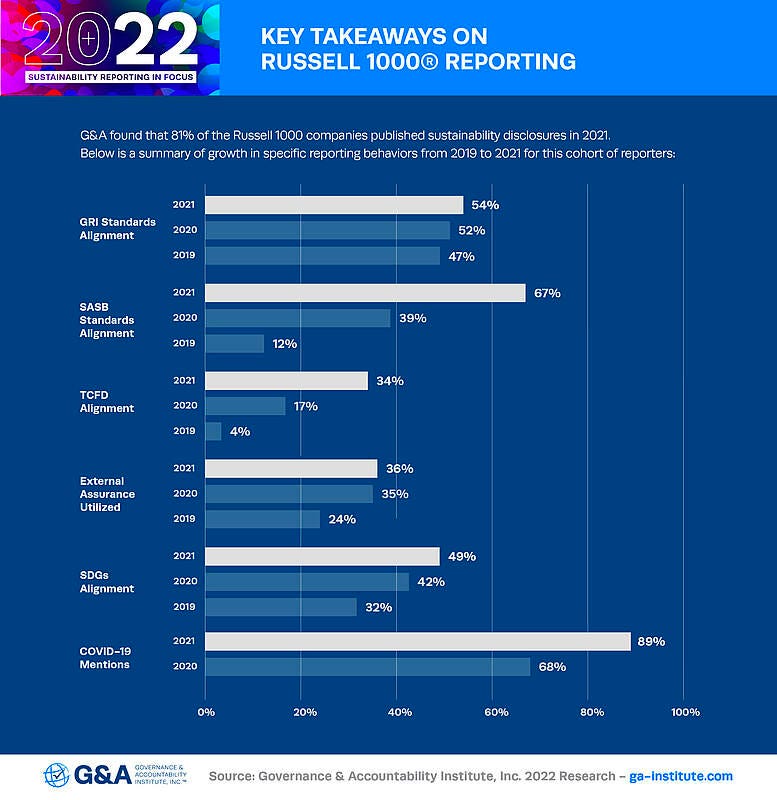
The original graph can be found and linked from here.
Companies are backing up their reporting by incorporating sustainability into their DNA. Because sustainability practices cannot merely be lip service anymore, companies must embed sustainability into corporate strategies. Boardrooms are having serious discussions about long-term sustainability commitments, recognizing that these are no longer peripheral matters but central to their survival and growth. For many, this means adopting ambitious carbon neutrality commitments. The growth of net-zero commitments among publicly traded corporations is a testament to this shift. In late 2020, there were 417 such commitments; by mid-2023, this number had surged to 929.
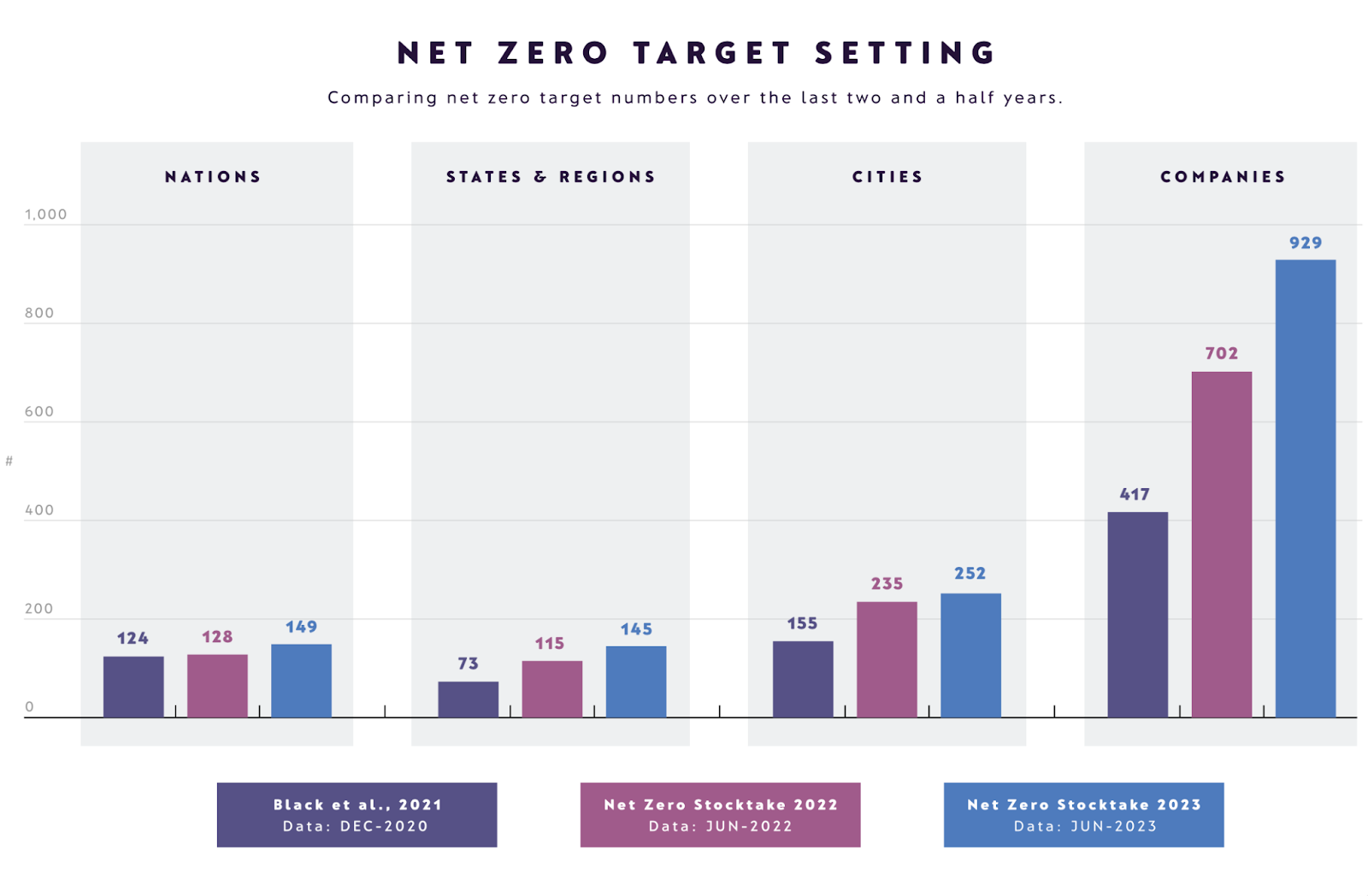
The original graph can be found and linked from here.
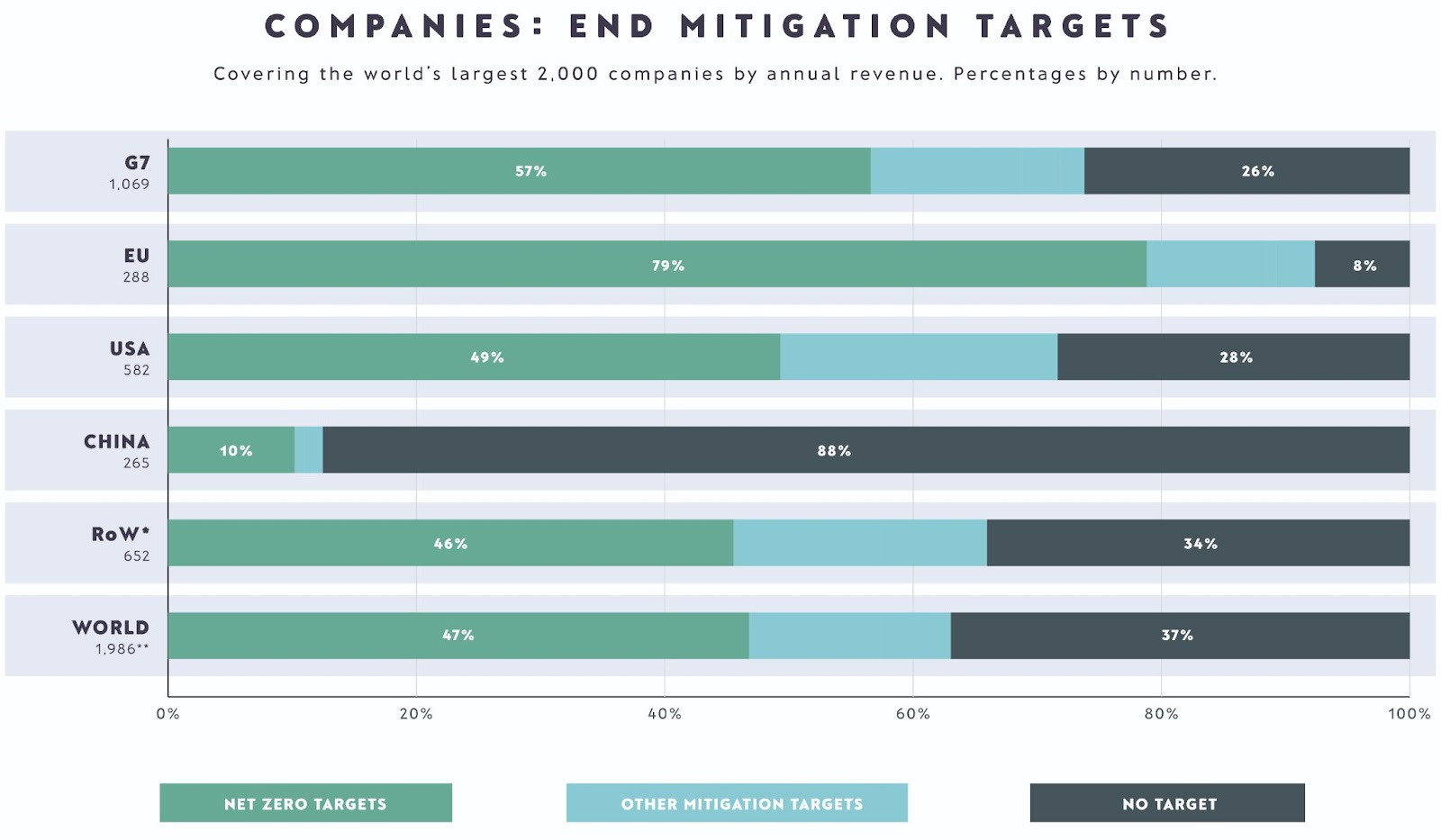
In the US, a whopping 49% of the largest corporations have made a Net Zero target, while a further 23% have made other mitigation targets (think significant ESG goals other than carbon neutrality). We expect this number to continue growing exponentially. See how we stack up to other economies below.
Response #2: Creating Sustainable Products
So, what does this new policy implementation look like at the ground level? One of the biggest ways companies need to meet their goals is by transforming their product offerings. The modern consumer isn't just seeking convenience; they are demanding products that echo their values. Sustainable products are hitting shelves at their highest rate ever: products marketed as sustainable grew ~2x faster than products not marketed as sustainable and achieved a 5-YR CAGR of 9.43% vs. 4.98% for their conventional counterparts.
A great example of this shift is the consumer packaged goods (CPG) sector. Looking at the sector at the corporate level, 52% of CPG companies say that sustainability is in their top three priorities. Diving deeper, research conducted by a team from the NYU Stern Center for Sustainable Business found that "...while sustainability-marketed products make up only 17.3% of total (CPG) sales, they are responsible for 30% of the growth in the sector. In fact, in 2021, one of every two new CPG products sold had one or more sustainability attributes. Some categories such as dairy, yogurt, and toilet paper have more than 60% of products sold with sustainable attributes." Similar product offerings can be seen across essentially every consumer product sector sold in America today, from things as small as face serums (C16 Biosciences) to reusable food containers (Dispatch Goods) to clothing (Bloom Labs). Companies are reimagining their offerings to align with the sustainability narrative consumers want and regulators demand.

Photo: Consumer Reports
So how are corporations actually going to create and scale more sustainable products?
From Goal Setting to Action: Corporate Venture Capital and Accelerators
For corporations to enact true and lasting change, many companies are seeking external innovations in the form of climate tech startups. A notable trend in the investing landscape today is the surge of Corporate Venture Capital (CVC) arms and corporate accelerators with a laser focus on climate tech. This strategic shift is more than a financial investment, it's a profound integration into the core business strategies of these corporations.
Corporate Venture Capital (CVC): Pioneering the Green Frontier
Beyond philanthropy or mere compliance with regulations, CVCs offer a dynamic approach to integrating sustainability into a corporation's DNA. By strategically investing in early-stage climate tech startups, corporations gain more than just a financial stake. They gain a front-row seat to cutting-edge technologies and are often the startup’s first customer, sometimes allowing them a certain influence over product development itself. It’s a win-win for both corporations and startups: each one has something that the other needs–startups are nimble and have innovative tech, and corporations have scale and money to bring those innovations to market.
To put this into scale, we estimate that CVCs were involved in 30% of all VC investments last year, equalling approximately $774 billion in AUM in 2022. Within the last 5 years, some of the largest and most prestigious CVCs have recognized the opportunity and importance of climate-focused investments and have made significant shifts in their strategies to invest in this segment. Traditional energy companies have led the charge with BP Ventures deploying over $1B in capital already, with their investments being labeled “a critical enabler of BP’s commitment to be net zero by 2050”. Additionally, Shell Ventures launched a $1.4 billion fund to invest in the clean energy transition while Chevron Technology Ventures is currently investing out of their second Future Energy Fund ($300M). Notable CVCs across almost every industry have joined the charge towards climate investing, including big names like Google Ventures ($30M through Google.org’s Impact Challenge), National Grid Partners ($150M), BMW i Ventures ($300M), Bosch Ventures ($295M), and SalesForce Ventures impact fund ($100M), to name a few.
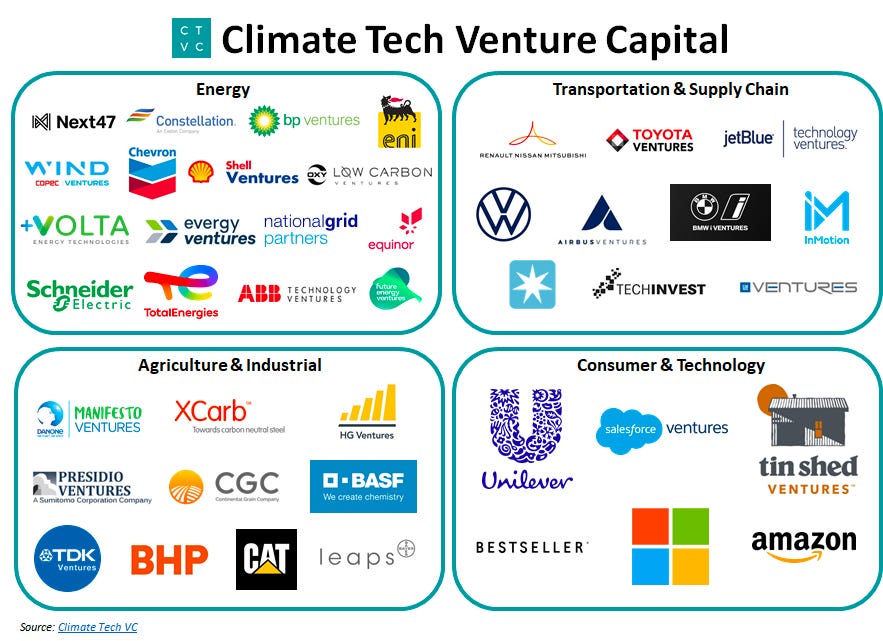
Source: Climate Tech VC
Accelerating Change: Corporate Accelerators and Grants
In tandem with the rise of CVCs, corporate accelerators and grant programs focusing on climate tech have emerged as powerful catalysts for change. These accelerators provide a structured framework for startups to fast-track their growth while allowing corporations to help shape and harness cutting-edge technologies at their earliest stages. The collaborative nature of these programs fosters an environment where startups benefit from corporate mentorship, access to extensive resources, and a potential launchpad into mainstream markets. Typically, the sponsoring corporations don't take an equity position in the venture, and the startup isn't held in an exclusivity or non compete clause. This gives the startup great exposure to the larger industry while maintaining flexibility, and often attracts other powerful corporations as early customers.
Case in point: Keel Labs (formerly known as AlgiKnit)
A vivid illustration of the transformative power of corporate accelerators unfolds in the story of Keel Labs (formerly Algiknit) and the Fashion for Good Plug and Play Accelerator. In 2018, Keel Labs participated in this collaborative initiative involving Fashion for Good, with C&A Foundation as a founding partner, Plug and Play, and corporate partners Kering, Galeries Lafayette Group, and C&A. Emerging from this accelerator, Keel Labs, which transforms sea kelp into sustainable yarns and textiles, garnered not only early-stage funding, but also invaluable insights and support from industry giants.
Since graduating in 2018, the young venture has grown at an impressive clip - Keel Labs secured $13M in Series A funding last summer, with participation from corporate powerhouses H&M and LVMH's venture arms. Following their fundraise, Keel Labs established a production facility in the Research Triangle of North Carolina where they can achieve commercial-scale production of their innovative yarns.
Just last month, Keel Labs marked a standout moment as their collaboration with renowned fashion designer Stella McCartney debuted at Paris Fashion Week. As part of McCartney's Spring 2024 show, she premiered two crochet knit looks created from Keel Lab's sustainable kelp-based yarn, Kelsun.

Source: Vogue.com
The support from corporate accelerators not only accelerated Keel Labs' growth, but also facilitated strategic partnerships with major players in the fashion industry. Keel Labs stands today as a beacon of successful collaboration. Keel Labs demonstrated how startups, armed with innovative climate solutions, can seamlessly integrate into ecosystems of established corporations, driving sustainability and innovation hand in hand.
Wrap It Up: A Role for Consumer Climate Tech Companies
The interplay of consumer demand and regulatory pressure is compelling companies to adapt, change, and innovate. As these dual forces converge, companies are rethinking not only what they produce, but also how they operate. This intersection presents an immense opportunity for growth, collaboration, and transformation.
In this seismic shift, we see an immense opportunity for consumer climate tech companies. As corporations work to fulfill their sustainability commitments, they are increasingly seeking innovative partners who can help them achieve their net-zero targets. This creates a fertile ground for consumer climate tech startups to form strategic partnerships, secure investments, and even be acquired by these legacy corporations. From electric vehicles (Lightship) to plant-based meat alternatives (SCiFi Foods), and household appliances (Copper) to energy (Dimensional Energy), consumer-focused climate tech is fertile ground in which corporations can play.
In the next article of this series, we will delve deeper into the historical and proven returns of consumer climate tech–if we haven’t convinced you yet, we think the numbers will show that this isn’t a sector you want to sleep on–unless the mattress cover is made from natural synthetic fibers, of course!