


🎧 We’ve got a hot new episode of Hope Dose for you!
"That's the whole purpose of SPUN, to turn the world a little bit upside down." — Jason Cremerius
📻 Listen to the episode on Spotify, Apple Podcasts, Amazon Music and Substack 👉
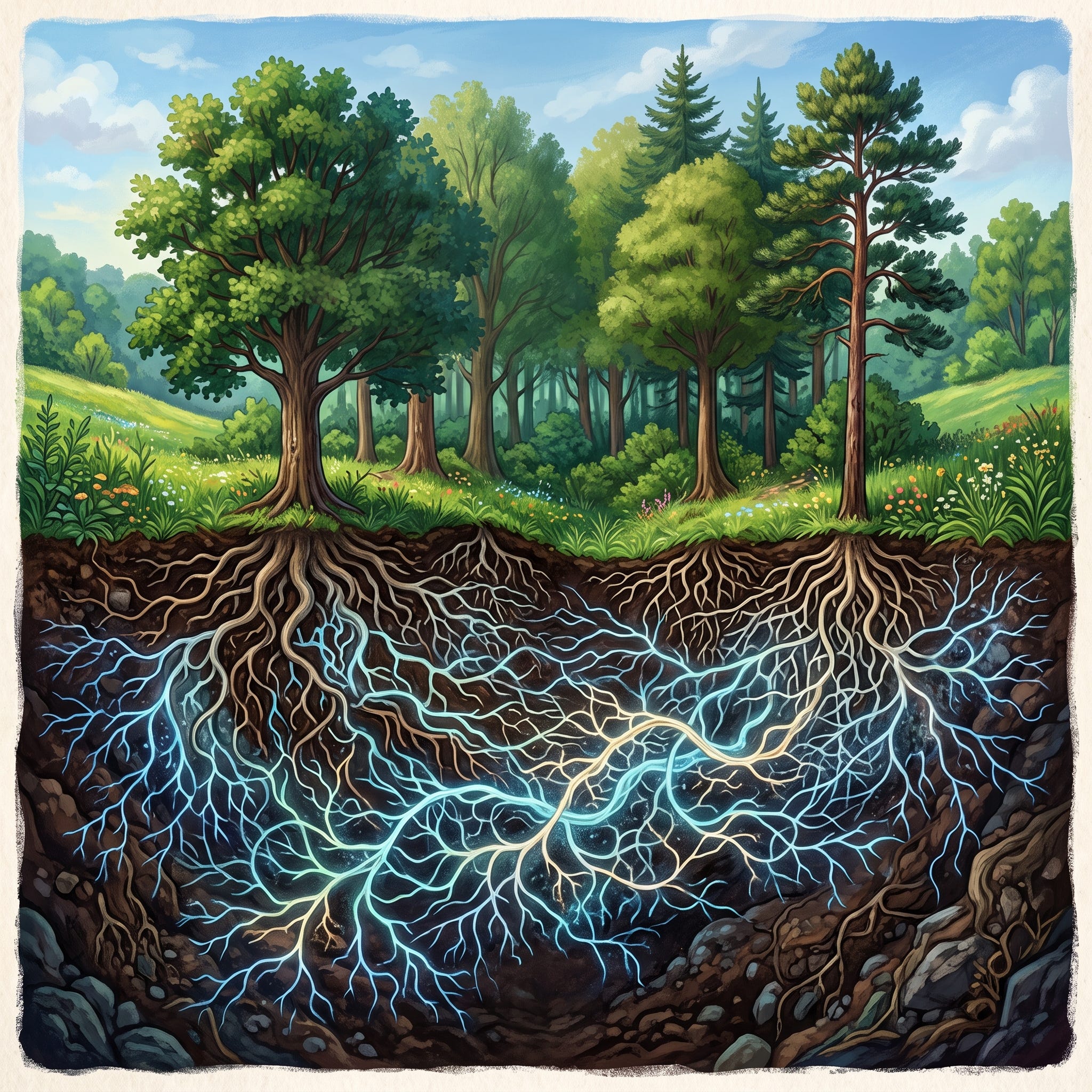
Beneath every forest, grassland and farm is a living network most of us have never seen. Mycorrhizal fungi partner with about 90% of land plants. They trade nutrients for carbon in a relationship that is 450 million years old, and they pull a staggering amount of CO₂ into the soil every year.
Matt sits down with Jason Cremerius, Managing Director and Chief Strategy Officer of SPUN (the Society for the Protection of Underground Networks). SPUN was co-founded by evolutionary biologist Toby Kiers, who recently won both a MacArthur “genius” award and the Tyler Prize, often called the Nobel Prize for the environment. SPUN’s mission is to map the world’s underground fungal networks so that we stop making decisions based only on what we can see.
📻 Listen to the episode on Spotify, Apple Podcasts, Amazon Music and Substack 👉
The conversation covers:
How fungi bury carbon in the soil, mostly through their own dead bodies (”necromass”)
Why grasslands turned out to hold some of the densest fungal networks on Earth
How SPUN built a global map at 1 km² resolution using machine learning
The goal of eventually detecting fungal communities from space
Why 80–90% of commercial fungal inoculants arrive dead
Why monoculture tree planting so often fails
Jason also brings a venture lens. He started in venture studios and corporate VC, so he makes the investment case for:
Microbial-scale biological sensing
Nature credits that measure what actually matters
Fungal startups like Funga
Supply-chain biodiversity intelligence
A hybrid philanthropic-venture model he calls “DARPA for the environment”
He closes on what gives him hope: standing in the rain in western Britain, watching researchers study the soil to bring back a lost temperate rainforest.
Chapters / timestamps
00:00 — Welcome: Williamsburg vs. Greenpoint, and the dreaded G train
01:25 — Is there a mycelial network under Brooklyn? Sampling under-sampled cities
02:30 — What is SPUN? Founding story and Toby Kiers
03:09 — Mycorrhizal fungi 101: 90% of plants and a 450-million-year partnership
04:16 — Beyond the “wood wide web”: the carbon story
05:48 — Carbon for nitrogen and phosphorus, and how trees learned roots from fungi
07:29 — Necromass: how fungi bury carbon as they live and die
08:25 — 13 billion tons a year, about a third of fossil emissions
09:37 — Do fungi help trees pull down more carbon? Biodiversity, turnover and a 64% productivity boost
11:37 — The grassland surprise
12:26 — California’s grassland fires and how quickly grasslands can recover
13:51 — New species, globally rare fungi, and why so few fungi are on protected-species lists
15:38 — From data to products? Long-read DNA sequencing
16:50 — How the map is built: 25,000 samples, GlobalFungi, and machine learning at 1 km²
18:28 — Getting to 10–30 meters: seeing fungi from space with satellite data
20:36 — Mapping the underground like the deep ocean, including SPUN’s deep-soil work
22:28 — Toby’s lab: robotics and machine learning that track carbon inside individual fungal threads
23:20 — The investor lens: Jason’s venture studio background
24:48 — Opportunity #1: biological sensing at the microbial level
25:42 — Opportunity #2: better incentives than today’s carbon and biodiversity credits
27:15 — Why mycelium materials and food are the “blunt” plays
28:41 — Agriculture and restoration: why 80–90% of commercial inoculum is dead on arrival
31:17 — Monoculture tree planting, and why about half the trees die within five years
34:26 — Funga, the startup that (pun intended) spun out of this science
36:56 — Patient capital, hybrid philanthropic-venture funding, and “DARPA for the environment”
38:56 — Venture studios built on nature data
40:07 — Opportunity #3: supply-chain biodiversity risk and EU reporting
41:11 — How to support SPUN: donate, follow along, use the open data
42:47 — What gives Jason hope: bringing back Britain’s temperate rainforest
44:39 — Wrap-up
Guest bio
Jason Cremerius is Managing Director and Chief Strategy Officer of SPUN. He works with founder Toby Kiers and the board to build SPUN into a platform that can scale its impact.
For two decades, Jason has built mission-driven organizations that rewire legacy systems to benefit people and the natural world. That work includes:
Designing platforms for global enterprises
Working in corporate venture capital
Advising startups and investors from day zero through exit
Co-founding b.theory ventures, a venture studio that incubates climate startups
He’s not a scientist by training. He came to fungi five years ago and had to get up to speed fast. He lives in Greenpoint, Brooklyn, right off the G line.
About SPUN: SPUN is a science-based nonprofit founded in 2021 to map and protect Earth’s mycorrhizal fungal networks. In 2025 it launched the Underground Atlas, published in Nature, the first high-resolution global map of underground fungal biodiversity. It found that more than 90% of fungal biodiversity hotspots lie outside protected areas.
Key takeaways
Mycorrhizal fungi partner with roughly 90% of land plants. Fungi deliver scarce nitrogen and phosphorus, and plants pay in carbon.
About 13 billion tons of CO₂ flows from plants into these fungi each year, roughly a third of fossil fuel emissions. How long that carbon stays in the soil is an open research question SPUN is studying.
More diverse fungal communities mean more nutrient trading. In some experiments, well-matched fungal partners made plants up to 64% more productive.
Grasslands, not just forests, hold some of the densest fungal networks. They’re vulnerable, but they also recover faster when restored.
Fungal partnerships are hyper-local. Non-native inoculants, most of which are dead on arrival anyway, don’t transfer well. That’s a hard problem for markets that want one product to work everywhere.
Jason’s three investable themes: microbial-scale environmental sensing; nature-based credits that capture real complexity; biodiversity intelligence for corporate supply chains.
SPUN’s data is open. Entrepreneurs with novel use cases are invited to reach out.
Links & resources mentioned
SPUN: spun.earth
Underground Atlas: spun.earth/underground-atlas
Toby Kiers: SPUN founder; 2025 MacArthur Fellow, 2026 Tyler Prize laureate
GlobalFungi: the fungal DNA database behind SPUN’s baseline model
Funga (founder Colin Averill): fungal inoculants for Southeastern US pine forests
Azolla Ventures: Funga investor
Grantham Foundation and Quadrature Climate Foundation: hybrid philanthropic funders mentioned
“Mycorrhizal mycelium as a global carbon pool” (Hawkins et al., Current Biology, 2023): the 13-billion-ton study
The Lost Rainforests of Britain by Guy Shrubsole: likely the book Jason refers to (confirm with him)